Trading Recommendations with Katbot
Katbot can provide trading recommendations based on market data and user preferences. This guide will walk you through the process of setting up and using Katbot for trading recommendations.
How Katbot Agenic Analysis and Trading Recommendations Work
Katbot leverages advanced AI algorithms to analyze market trends, historical data, and user-defined parameters to generate trading recommendations. By understanding your risk tolerance, investment goals, and preferred trading pairs, Katbot can suggest trades that align with your strategy. It does this by accessing real-time market data and applying machine learning techniques to identify potential opportunities. Here are the key components that the Katbot Agent uses to provide trading recommendations:
- Market Data Analysis: Katbot continuously monitors market conditions, including price movements, volume, and volatility, to identify trends and patterns.
- Risk Metrics: Looks at the current risk factors associated with the portfolio state to influence different trading options to help balance potential rewards against possible losses.
- Position Sizing: Determines the appropriate size for each trade based on your portfolio size, risk tolerance, and market conditions to optimize potential returns while managing risk.
Getting Trading Recommendations From Katbot
The new recommendation system offers two approaches - predefined prompt templates for quick access, and custom instructions for personalized strategies:
- Access the Recommendations Panel: Navigate to your portfolio dashboard and locate the "Agenic Trading Recommendations" section.
- Choose Your Approach:
- Quick Prompts: Select from predefined templates (Basic or Trader mode)
- Custom Instructions: Write your own specific trading criteria and preferences
- Generate Recommendation: Click "Generate Recommendation" and wait for Katbot to analyze market conditions (typically 1-2 minutes).
- Review Results: Your recommendation will appear in the recommendations list with detailed entry/exit points and reasoning.
- Execute Trades: Use the provided trade details to make informed trading decisions through your exchange.
Recommendation Modes: Basic vs Trader
Katbot offers two distinct prompt modes to match your experience level and trading style:
Basic Mode
Perfect for beginners or users who want straightforward, easy-to-understand recommendations. Basic prompts focus on: - General market analysis and trend identification - Simple risk assessment and portfolio balance - Clear entry and exit strategies - Beginner-friendly explanations
Trader Mode
Designed for experienced traders who want detailed, technical analysis-driven recommendations. Trader prompts include: - Advanced technical analysis with specific RSI, volatility, and momentum parameters - Sophisticated risk management with precise position sizing calculations - Multi-directional strategies (long/short opportunities) - Portfolio hedging and delta-neutral strategies - Statistical mean reversion and breakout patterns
You can toggle between modes using the switch in the recommendations panel - your preference will be saved for future sessions.
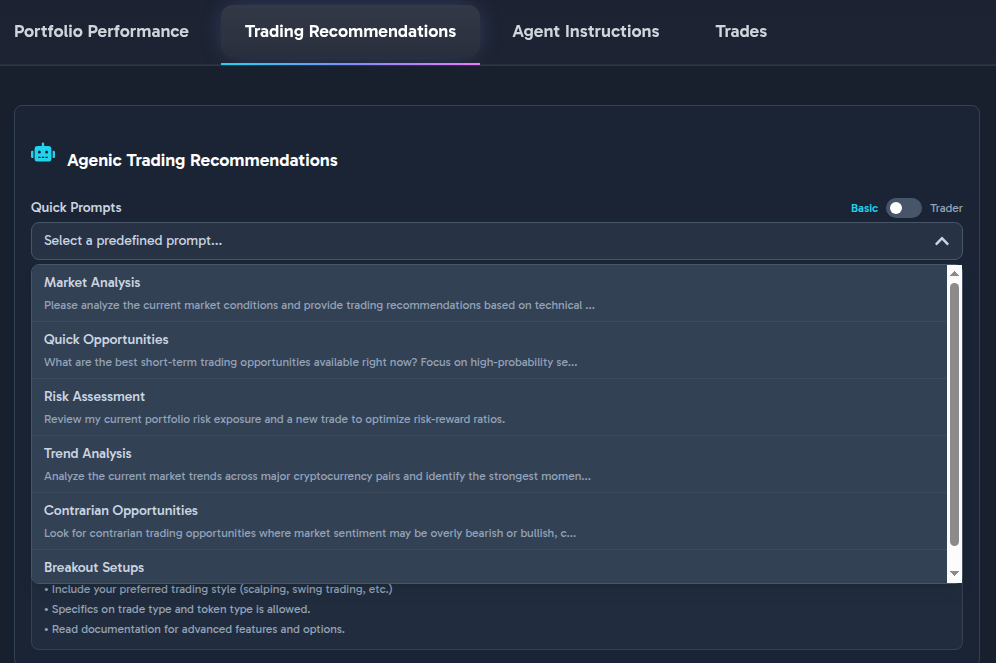
Predefined Prompt Categories
Basic Mode Prompts
- Market Analysis: General market condition analysis with technical indicators and sentiment
- Quick Opportunities: Short-term trading setups with clear entry/exit points
- Risk Assessment: Portfolio risk review and optimization suggestions
- Trend Analysis: Major cryptocurrency trend identification and momentum plays
- Contrarian Opportunities: Counter-trend setups when sentiment is extreme
- Breakout Setups: Key resistance/support level analysis for breakout trades
Trader Mode Prompts
- Bullish Trend Pullback: Long entries on pullbacks in established uptrends
- Bearish Trend Rally: Short entries on relief rallies in downtrends
- Volatility Breakout: Bi-directional breakout strategies with volume confirmation
- Range Fade: Mean reversion trades in ranging markets
- Statistical Mean Reversion: Counter-trend scalps based on RSI extremes
- Portfolio Hedge: Delta-neutral strategies to balance portfolio risk
- Best Opportunistic Trade: Highest conviction trade regardless of direction
Creating Custom Instructions
While predefined prompts cover most scenarios, you can create custom instructions tailored to your specific needs. Here's how to craft effective custom prompts:
Structure for Custom Prompts
- Specify Direction: Long, Short, or Bi-directional
- Define Timeframe: Short-term (hours), Medium-term (days), or Long-term (weeks)
- Set Risk Parameters: Risk tolerance, position size preferences
- Include Market Conditions: Trending, ranging, volatile, etc.
- Add Asset Preferences: Specific tokens, market cap ranges, or exclusions
Custom Prompt Examples
Conservative Long-term Strategy:
Recommend a LONG position for a 2-3 week hold with low risk tolerance.
Focus on established cryptocurrencies (top 20 by market cap) showing
strong fundamentals and technical support. Use tight stop losses
(max 3% risk) and realistic profit targets. Avoid meme coins or
highly volatile assets.
Aggressive Scalping Setup:
Find a high-probability scalping opportunity for the next 2-4 hours.
I'm comfortable with 5% portfolio risk and prefer assets with high
volume and clear technical levels. Looking for either direction
(LONG/SHORT) with tight entry/exit criteria. Focus on major pairs
like BTC, ETH, SOL with strong momentum indicators.
Contrarian Value Play:
Identify an oversold cryptocurrency that has dropped 20%+ in recent
days but maintains strong fundamentals. Looking for a LONG position
with 3-5 day holding period. Use dollar-cost averaging entry
strategy and focus on assets near major support levels.
Maximum 2% portfolio risk per position.
Portfolio Rebalancing:
Analyze my current portfolio allocation and recommend a trade to
improve diversification. I'm currently overweight in DeFi tokens
and want exposure to gaming or AI cryptocurrencies. Suggest either
a new LONG position or reducing existing exposure through strategic
exits or SHORT positions.
Momentum Breakout Strategy:
Find cryptocurrencies breaking out of consolidation patterns with
increasing volume. Looking for 4-6 hour momentum plays with clear
breakout levels. Willing to risk 3% of portfolio on high-conviction
setups. Prefer assets that haven't moved significantly in the past
week but show signs of accumulation.
How Katbot Recommendations Work
When you submit a recommendation request, here's what happens:
- AI Analysis: Katbot analyzes current market data, technical indicators, and your portfolio state
- Strategy Formation: Based on your prompt, Katbot develops a specific trading strategy
- Risk Calculation: Position sizing and risk parameters are calculated based on your portfolio size
- Recommendation Generation: A detailed recommendation is created with exact entry/exit levels
Sample Recommendation Output
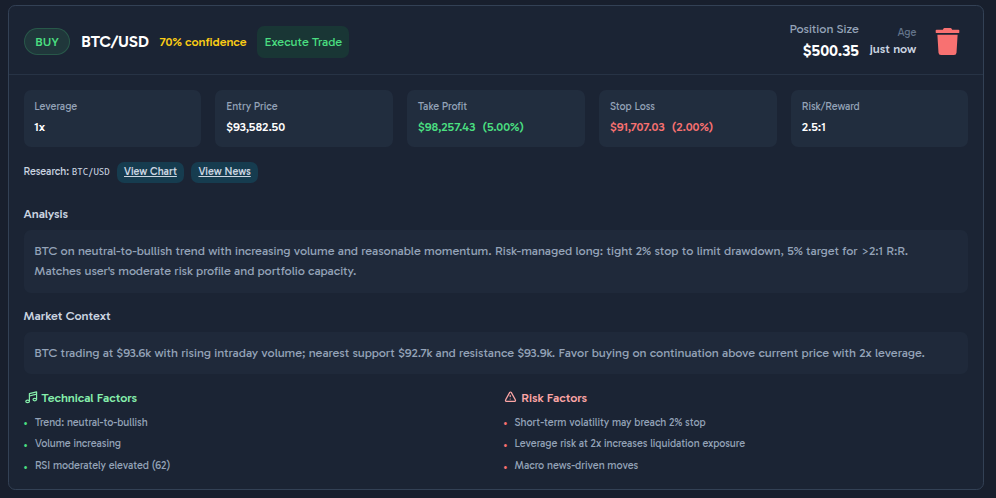
Here's an example of what a Katbot recommendation looks like:
I recommend one trade based on your moderate-risk allocation.
Trade Recommendation
Action: BUY BTC/USD (long)
Entry: 93,578.50 USD (current market price)
Take-profit: 98,257.43 USD (+5.0%)
Stop-loss: 91,707.03 USD (-2.0%)
Position size: $500.35 (risks 1% of portfolio)
Leverage: 2.0x
Risk-reward: 2.5 : 1
Confidence: 0.70
Reasoning:
BTC shows neutral-to-bullish intraday structure with increasing volume and positive momentum.
RSI ~62 — not overbought for a continuation move.
Tight 2% stop keeps dollar risk within your risk management limits; 5% TP yields >2:1 reward-to-risk.
Position uses 2x leverage to align with moderate risk tolerance.
Risks:
- Short-term volatility could trigger the tight stop
- Macro headlines can produce rapid moves and slippage
- Leverage increases liquidation risk; monitor closely
Your recommendations will appear in the Katbot Recommendations Dashboard:
## Advanced Custom Prompt Techniques
For experienced traders, here are advanced prompting techniques to get more sophisticated recommendations:
### Multi-Criteria Analysis
```text
Analyze the top 10 cryptocurrencies by volume and identify the best
LONG setup that meets these criteria: RSI between 40-60, increasing
volume over 48 hours, price above 20-day EMA, and not overbought
on 4-hour timeframe. Provide detailed technical analysis and risk
management strategy.
Sector-Specific Strategy
Focus on DeFi tokens showing accumulation patterns. Looking for a
LONG position in an established protocol (min $100M market cap)
that has underperformed recently but shows signs of revival.
Consider TVL trends, protocol revenue, and upcoming catalysts
in your analysis.
Risk-Parity Approach
Recommend a pair trade opportunity: one LONG and one SHORT position
that hedge against each other while capturing relative performance.
Focus on correlated assets with diverging technicals. Ensure
combined position risk doesn't exceed 2% of portfolio value.
Short-Term Scalping
Find a high-probability scalping opportunity for the next 2-4 hours.
Focus on major pairs with clear support/resistance levels and high
volume. Looking for either LONG or SHORT with tight risk management -
maximum 1% stop loss and 2-3% profit target. Prefer assets showing
momentum divergence on shorter timeframes.
Long-Term Value Strategy
Identify an undervalued cryptocurrency for a 2-4 week hold period.
Focus on fundamentally strong projects trading below fair value due
to market sentiment. Analyze on-chain metrics, development activity,
and partnerships. Use a dollar-cost averaging approach with 3-5%
portfolio allocation and wide stop loss (15-20%).
Tips for Effective Prompting
- Be Specific: Include timeframes, risk tolerance, and preferred asset types
- State Direction: Clearly mention if you want LONG, SHORT, or both directions considered
- Define Risk Parameters: Specify maximum risk per trade and position sizing preferences
- Include Market Context: Mention current market conditions or specific technical levels
- Add Constraints: Exclude certain assets or include specific requirements (market cap, volume, etc.)
- Request Details: Ask for specific entry/exit levels and reasoning behind recommendations